

LAUGH, AND THE WORLD LAUGHS WITH YOU!
The father of advertising, David Ogilvy, firmly believed that “In the modern world of business, it is useless to be a creative, original thinker unless you can also sell what you create”. The entire value chain that contributes to creating a product and making people aware of its benefits needs to come together in a way that people are willing to pay a price to get it, over and over again. In the limited context of this article , it can be said that all efforts towards market research, marketing, promotion, merchandising, and advertising should be aligned perfectly so that consistent sales can be achieved.
In this piece, let us take a look at one aspect of these disparate yet interlinked elements – advertising. An advertisement is sometimes used to make people aware of a new product or service, at other times to reiterate the benefits of an existing product, and sometimes just to announce some new promotions. Whatever the purpose of advertising, the trick in getting it to actually sell products successfully rather than becoming a boring documentary, is to keep the messaging interesting as well. As another guru of advertising, Leo Burnett, said, “I am one who believes that one of the greatest dangers of advertising is not that of misleading people, but that of boring them to death”. One of the best ways to make an advertisement memorable and effective is to inject a healthy dose of humor into it. The use of humor across different media over the years has been a surefire way for an advertisement to grab attention, and then ensure that customers stick on to the product or service being advertised.
Long before social media or even television became the staple medium for companies to advertise their products, newspapers and magazines were the way for advertisers to reach their customers. Print advertisements generally use a clever mix of a relevant picture and/or humorous copy to get the point across. But unlike television or social media ads, most humorous print ads evoke a smile at best, instead of creating laugh-out-loud (LOL) or rolling-on-floor-laughing (ROFL) moments.
THE PRECISION OF VOLKSWAGEN
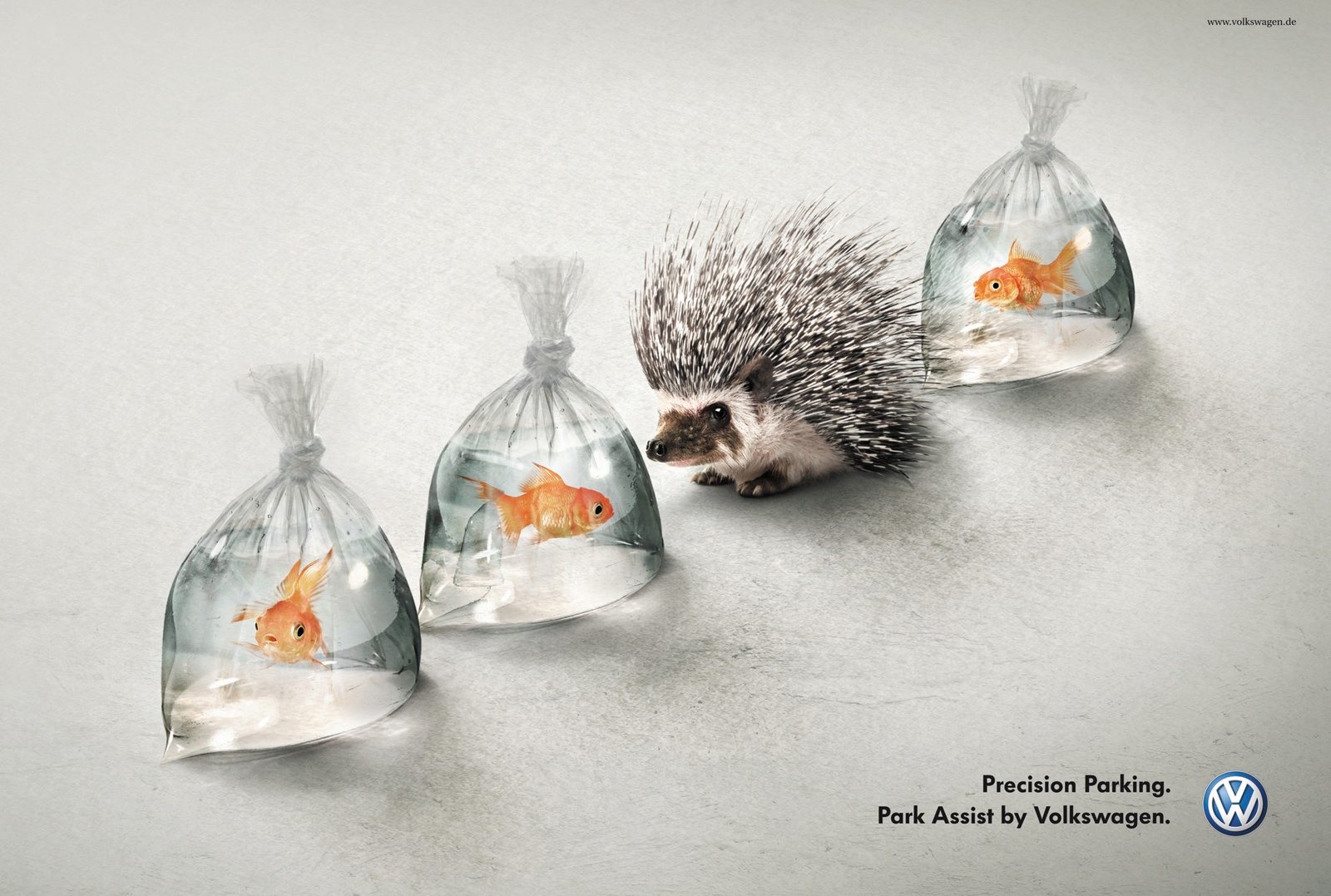
Volkswagen, for example, used images seemingly unrelated to cars while advertising their Precision Parking and Park Assist features. The ad showed a line of goldfish swimming around in almost-ready-to-burst bags, and a spiky porcupine wedged precariously in between them, which could easily burst any of those bags if not precisely placed. Volkswagen wanted to say that this was akin to the accurate and reliable parking assistance their cars provided even in situations with a very thin margin for error.
COMFORT IN THE QUIET
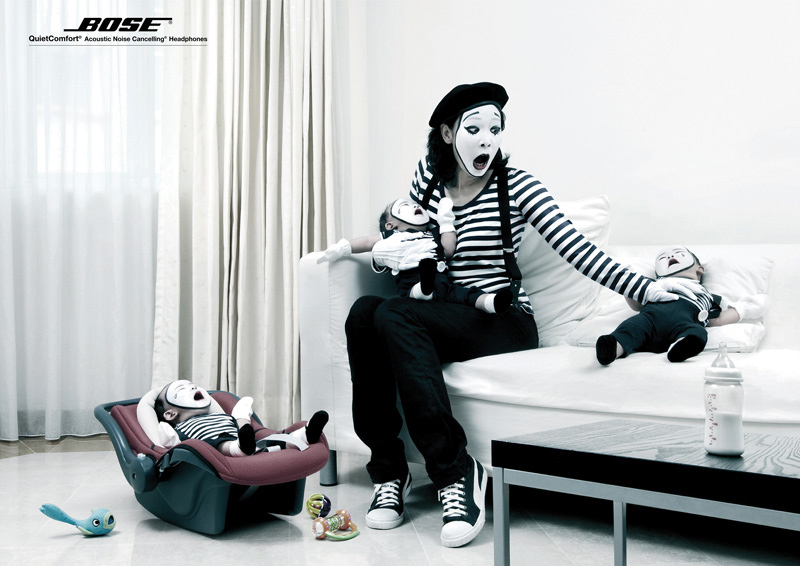
When it comes to home audio systems or speakers, probably the most respected name in the world is Bose. Still, they have always used an understated and subtly humorous style in their print advertisements. One of their popular product series is the Quiet Comfort range of noise cancelling headphones. The campaign for this set of products was a series of spots, in each of which a situation was described where there was some unwanted sound that everyone wants to shut out, like shouting, crying, yelling in pain etc. The catch? The scene was played out by characters dressed like mime actors, who never need any sound. Exactly like Bose headphones, which keep out all unwanted sounds, the ads wanted to say.
Source: https://www.adsoftheworld.com/
WHY DO WE LIKE IKE?
With television advertisements, it became much easier to tell a humorous story in 10, 20, or 30 seconds, as opposed to a static picture accompanied by text. This led to an explosion of humourous ideas which went beyond a simple recounting of product benefits or service excellence. Unlike the present time, when we tend to either mute or fast forward most television ads, probably because there are so many, the earliest television advertisements were a welcome break from regular programming. People used to sing along to jingles and remember them for years.
Way back in 1952, Dwight Eisenhower used a catchy jingle with animated pictures to promote the idea of “I Like Ike” before the Presidential campaign, and political commentators attributed his victory in part to this commercial. The minute long advertisement wasn’t overtly humorous, but the use of animations and the jingle was a big change from the heated debates and venomous acrimony that was to become the staple of elections around the world in later years.
THE HEINEKEN PARTS
Heineken, the beer manufacturer, played on the theme of reaching those parts which other beers couldn’t refresh, to come up with several TV spots in the 1980s. One of them played on the theme of George Bernard Shaw’s Pygmalion, and used characters that seemed like Professor Henry Higgins and the flower girl Eliza Doolittle. In fact, one of the subsequent spots also played on the word ‘parts’ and showed how Heineken was a beer that could refresh even ‘pets’ whom other beers couldn’t reach.
WHEN YOU ARE HUNGRY
Another hilarious series of television ads, called ‘you are not you when you are hungry’ was presented by Snickers from 2010 onwards, which drove home the fact that hunger often turns us into people we normally are not. Additionally, apart from humor, Snickers used another favorite ploy of ads for this series, which was to use celebrities like Betty White, Joan Collins, and others to play themselves. No wonder, then, that this gave a big boost to the sales figures of Snickers pretty quickly and consistently.
ALL FOR A DOLLAR
More recently, a great example of awesome business results from a funny yet thought provoking TV commercial was the one released by Dollar Shave Club, which took a swipe at costlier razor blades and also roped in their CEO to assure viewers in a matter-of-fact way, that their blades were cheap but not of inferior quality. The ad is hilarious, provided you can look beyond the profanity.
WRAPPED BY SPOTIFY
In the last ten years, though, television has given way to social media as the place people spend most of their waking hours at. The goldmine for advertisers was that social media ads provided opportunities to viewers and/or consumers to give real time feedback for not only the ad but also about the product or service being advertised. This shortened the feedback cycle drastically, allowing advertisers to correct their course when needed. Additionally, customers can become unpaid influencers for the brand when they comment or share on a particular post, or when they use a particular hashtag.
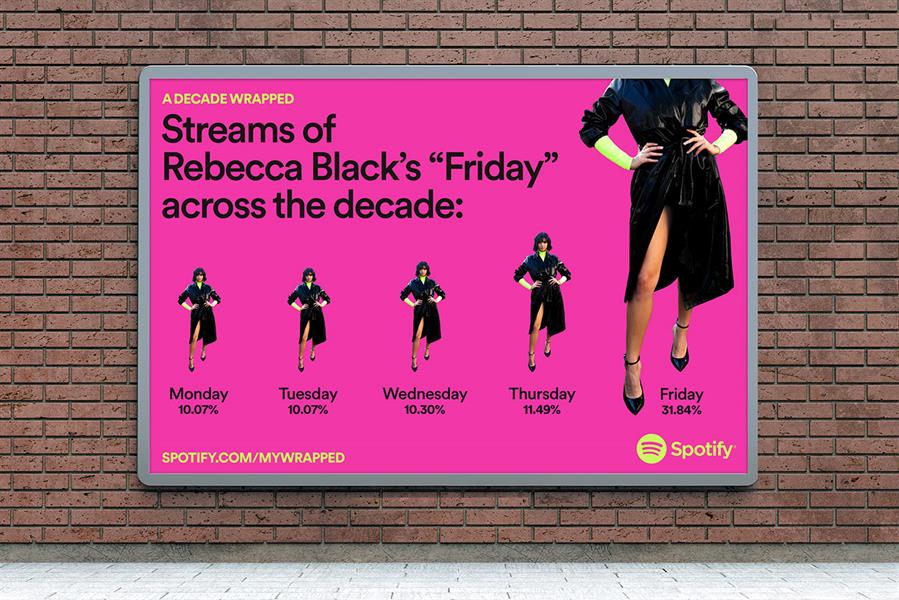
It is a badly kept secret that most corporations mine data from social media to understand customer preferences, which often borders on an intrusion of privacy. In 2015, Spotify began to provide their customers a view of their preferences over the previous decade, and then used some humorous or eye popping insights from these to advertise themselves, calling this campaign ‘Wrapped’. Because each customer’s Wrapped set brought back memories of what they had been doing or where they were several years back, therefore it prompted many customers to share their details, which indirectly became unpaid ads for Spotify too.
Source: https://www.campaignlive.co.uk/article/spotify-wrapped-2019-in-house/1667824
TOILET HUMOUR, ANYONE?
Irregular bowel movements have always been part of what is called ‘toilet humor’, but had never been dissected and discussed in excruciating detail in a commercial with such success before. The product Squatty Potty is disarmingly simple. It is just a small tool that improves stool, so to say. But to make an engaging ad out of it was not that simple. This ad used a perfect mix of humor, outrageous characters, and some cute descriptions of the ‘product features’ to make an iconic advertisement of what is generally considered an embarrassing or even boring product.
That brings us to the end of the commercial break, folks. We do hope you enjoyed the humorous ads presented in this article so far. Now we go back to the core issue of this article – how does humor help an advertisement, irrespective of the medium?
A CASE FOR HUMOUR
Notice how you wait eagerly for a chance to tell someone a great joke you heard somewhere? The best gift that humor gives to advertisements is to enhance their ‘shareability’ in these ‘social’ times, and they make you ask your coworkers or friends, ‘hey, have you seen this ad about…?’ It is not likely that you would ever discuss an advertisement that mostly consists of a staid retelling of the product features.
When a product or a service laughs at itself or pokes fun at someone in an ad, it is perceived as an entity that is more human, and therefore easier to trust.
It is very common to see people recall funny advertisements more easily than other ads, giving more bang to every advertising buck spent. This, of course, has a possible downside that we will come to in a bit.
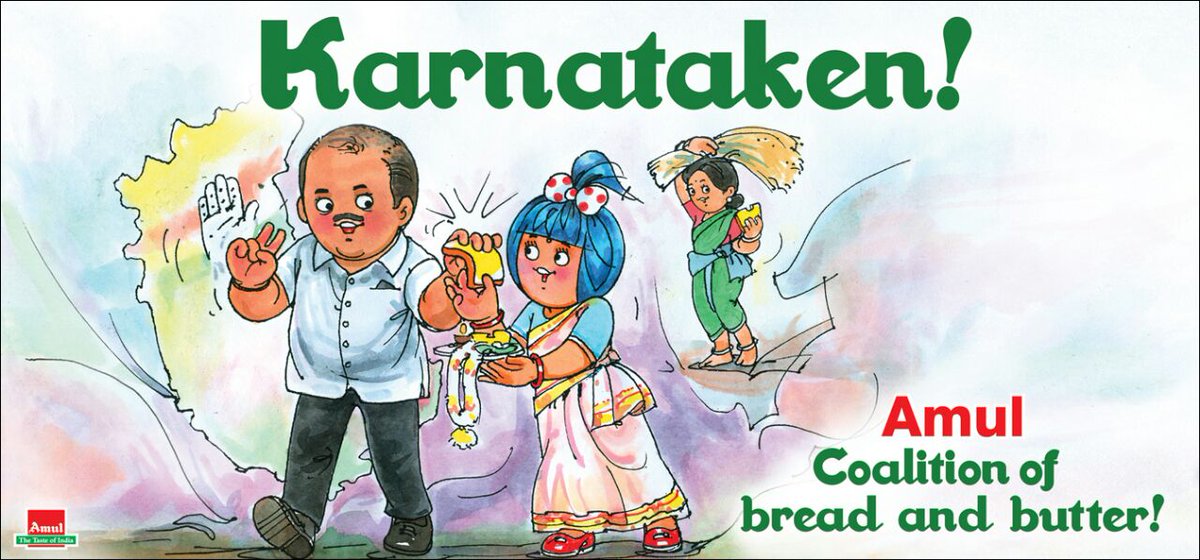
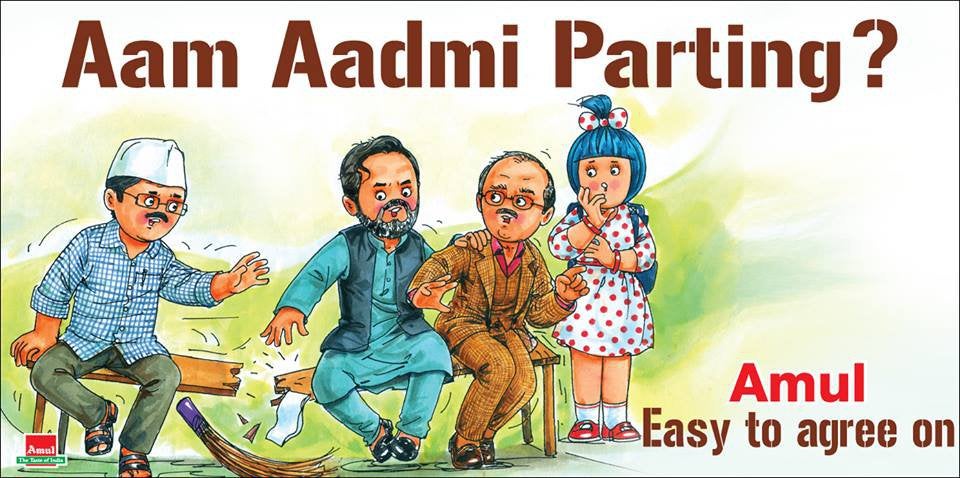
There are several examples where a brand has made itself a unique personality with the help of humour. Two such examples, both from India, are the Amul Butter hoardings and print ads on contemporary issues, and the Twitter handle of the Mumbai Police.
A WORD OF CAUTION, THOUGH
Unlike what we might presume, the study of the impact of humor used in advertisements is no laughing matter, and has been the subject of numerous serious studies as well. In 1991, Zhang and Zinkhan tried to understand the linkages between perceived humour in an advertisement, the recall of that ad, and the attitude towards that brand in their study titled Humor in Television Advertising: the Effects of Repetition and Social Setting. More than a decade later, Flaherty and others explored almost similar variables to assess The Impact of Perceived Humor, Product Type, and Humor Style in Advertising.
Both these studies also have a word of caution for advertisers. They talk of a very thin line, which, if crossed, can actually backfire on the advertiser. We have heard of so many examples of ads that ended up offending people instead of making them laugh. There are many well made and humorous ads which rubbed people the wrong way and ended up giving the advertiser a headache instead of the sweet sound of cash registers ringing. Kendall Jenner and Pepsi got bad press for trivializing social causes, Hyundai had to face a lot of backlash for making light of a sensitive subject like suicide, and some pieces of the Bud Light – up for whatever campaign seemed to almost encourage date rape by encouraging drinkers to take the word ‘No’ out of their vocabulary. Other commercials have had to be taken off because their poor communication led to confusion (Pepsi lottery in the Philippines, Burger King’s ‘Where’s Herb?’) or unintended sexual innuendo (Panasonic Woddy the Woodpecker), or even making people wonder why the advertiser wouldn’t want to pay taxes (AirBnB).
The other risk that a humorous ad carries is that people often remember the advertisement itself, but do not seem to remember the product or service being advertised. This situation is almost akin to a form of social service, where the advertiser is doing a good job of making people happy, but is not getting any benefit in return. Most industry experts are firmly of the opinion that advertising is very important for any brand. But they all caution about the advertisement eclipsing the brand or its message. To quote Ogilvy again, “A good advertisement is one which sells the product without drawing attention to itself”.
In conclusion, it can be said that humour can bring life to an advertisement in any medium, but like a well made dish, it should neither be undercooked nor overdone.
.Rate this Insight

 (24 votes, average: 4.79 out of 5)
 Loading...